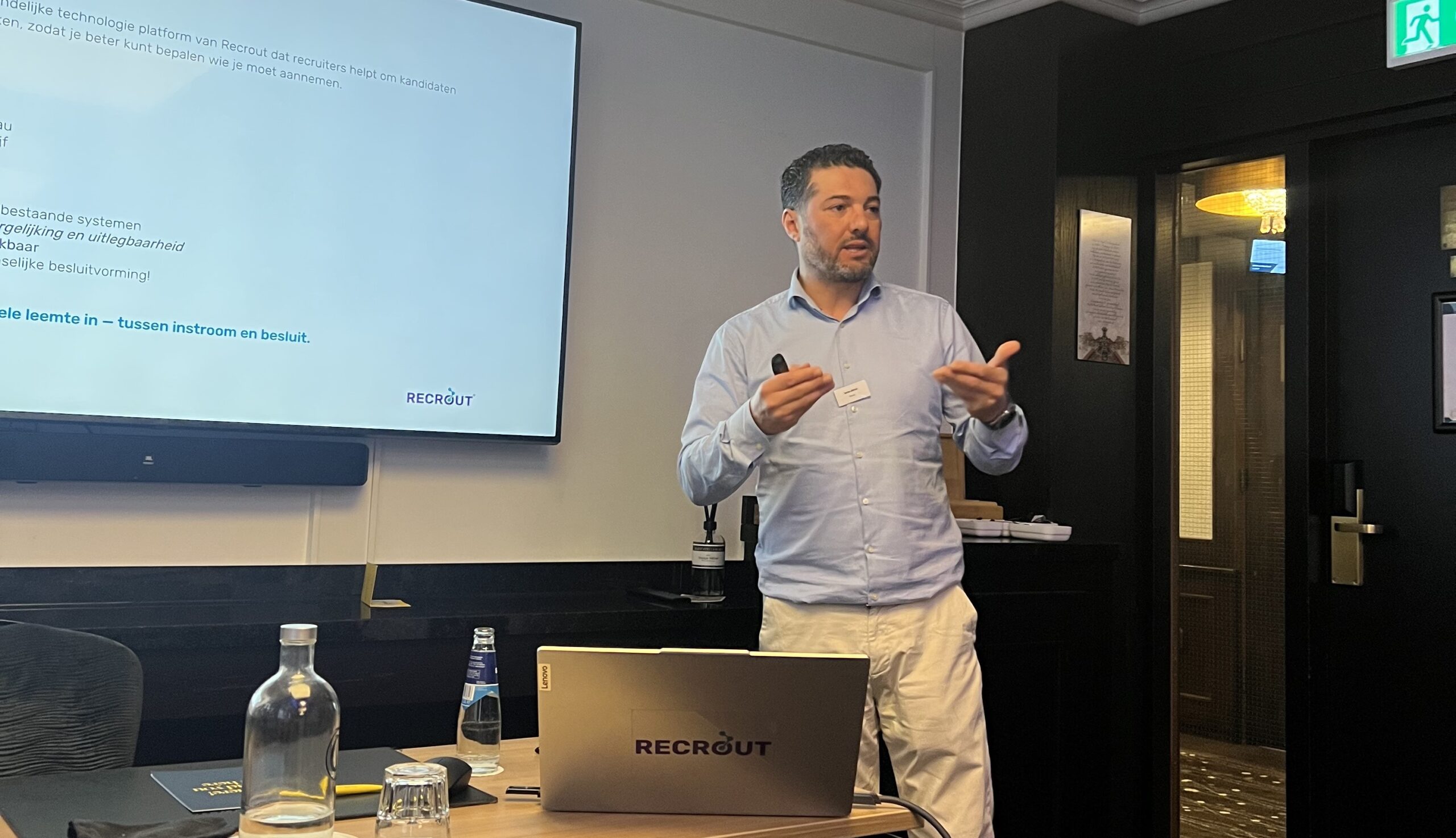

Successful remote collaboration—how do you do it? Karim Akhlal of HR tech company Recrout has years of experience and shares his tips. “There is no shortage of talent if you are open to remote work.”
“Long before remote work became the norm, I was more or less forced to work with developers remotely,” says entrepreneur Karim Akhlal. Akhlal is an expert in recruitment. After studying Human Resource Management, he worked for years as a recruiter. Frustrated by shortcomings in the recruitment process, he founded Recrout in 2015: a software provider that enables employers to find candidates based on personality profiles.
From gut feeling to science
His SME, Recrout, now has four permanent employees in the Netherlands and several freelancers abroad. They work for clients such as InHolland University of Applied Sciences and technology company Amazic.
“Our software makes the selection of new employees more objective,” he says. “Normally, recruiters select candidates largely based on a résumé and gut feeling. Our approach is scientific. We select employees based on personality traits such as competencies and talents.”
“I quickly started looking beyond the borders.”
The system Akhlal had envisioned didn’t exist yet. He had to have it built himself, but finding IT developers was challenging. “I couldn’t find the right people in the Netherlands, so I quickly started looking beyond the borders,” he says. “I found my first developer in Mauritius.”
He has never met her in person, he says. “And yet, we’ve been working together extremely well for over six years. I’m very happy with her. We know exactly what we can expect from each other.”
Make clear agreements
Such a good collaboration doesn’t happen automatically, he knows. When it comes to IT development, Akhlal always works with developers abroad. “Over the past few years, I’ve worked with about a dozen different people from various countries: Armenia, Pakistan, the Philippines,” the entrepreneur says. “Long before remote work became the norm, I was more or less forced to work with developers remotely. With varying success, and I’ve learned from that.”
The advantage of remote IT developers is that you can find suitable programmers more easily and quickly. “It’s important to set clear goals,” says Akhlal. “Freelance developers don’t have the same commitment or connection to your organization as your permanent employees. They just want to earn money. That doesn’t have to be a problem, as long as you make good agreements.”
Keep the conversation going and ask for updates
Think carefully about what you expect from the person working remotely for you. “Dare to hold each other accountable,” he says. “I once waited for weeks on a project because someone kept coming up with a new excuse—first they were sick, then it was their mother. When you’re on the other side of the world, you can’t verify if the story is true. In the end, it turned out they were working for six other clients, and I simply wasn’t a priority.”
To prevent this, Akhlal calls his remote team members daily or weekly for updates. He uses software management tools to assign tasks, receive code, and approve work. “The software is compartmentalized: not every developer has access to all the code, and not everyone can just make changes or view data,” the entrepreneur explains. “This way, we keep it secure.”
“You only know what someone is capable of once you work with them.”
Akhlal advises always agreeing on a trial period. “You only really know what someone is capable of once you work with them,” he says. “Within a month, you can usually get a good sense of whether it works. Use that time to assess performance and responsiveness. My experience: if in doubt, stop.”
In times of staff shortages, that may sound quite drastic. “Don’t worry—there is no shortage of talent if you are open to remote work,” says Akhlal. “Across the borders, there is plenty of supply. The trick is finding that one person with whom you really click.”
Looking for a healthy mix
His company also has employees in the Netherlands, including in sales and marketing. The COVID-19 lockdown two years ago had little impact on Recrout’s business performance. In fact, the number of employees grew. “The lockdown was inconvenient, but it also gave us, as a tech company, a push forward. Organizations became more open to digital solutions.”
Because the company operates so digitally, they were able to start working from home quickly during the lockdown. “But after a year at the kitchen table, I’m certain I wouldn’t want to work entirely remotely,” says Akhlal. With his core team, he aims for a “healthy mix” of remote and in-office work.
Passion for the cause
During live meetings, you pick up more signals, he explains. “From clients, but also from your team members. When you have coffee together or go for a walk, you can more quickly tell if someone is having a bad day. As an employer, you can take that into account.”
Moreover, he enjoys meeting people and brainstorming solutions together. “Of course, you can do a lot digitally, but in my opinion, real commitment is built at the office,” he says. “If you only work remotely, you can’t expect employees to fall in love with your company.”
3 Tips for Successful Remote Entrepreneurship:
- Pay attention to tax regulations and occupational health and safety laws when hiring someone across borders. The rules vary by country, even within Europe.
- Set clear agreements on performance and communication when working remotely. When will you check in with each other? What do you expect from them, and what can they expect from you?
- Also be mindful of things like time differences. If your team works across different time zones, it can cause delays.