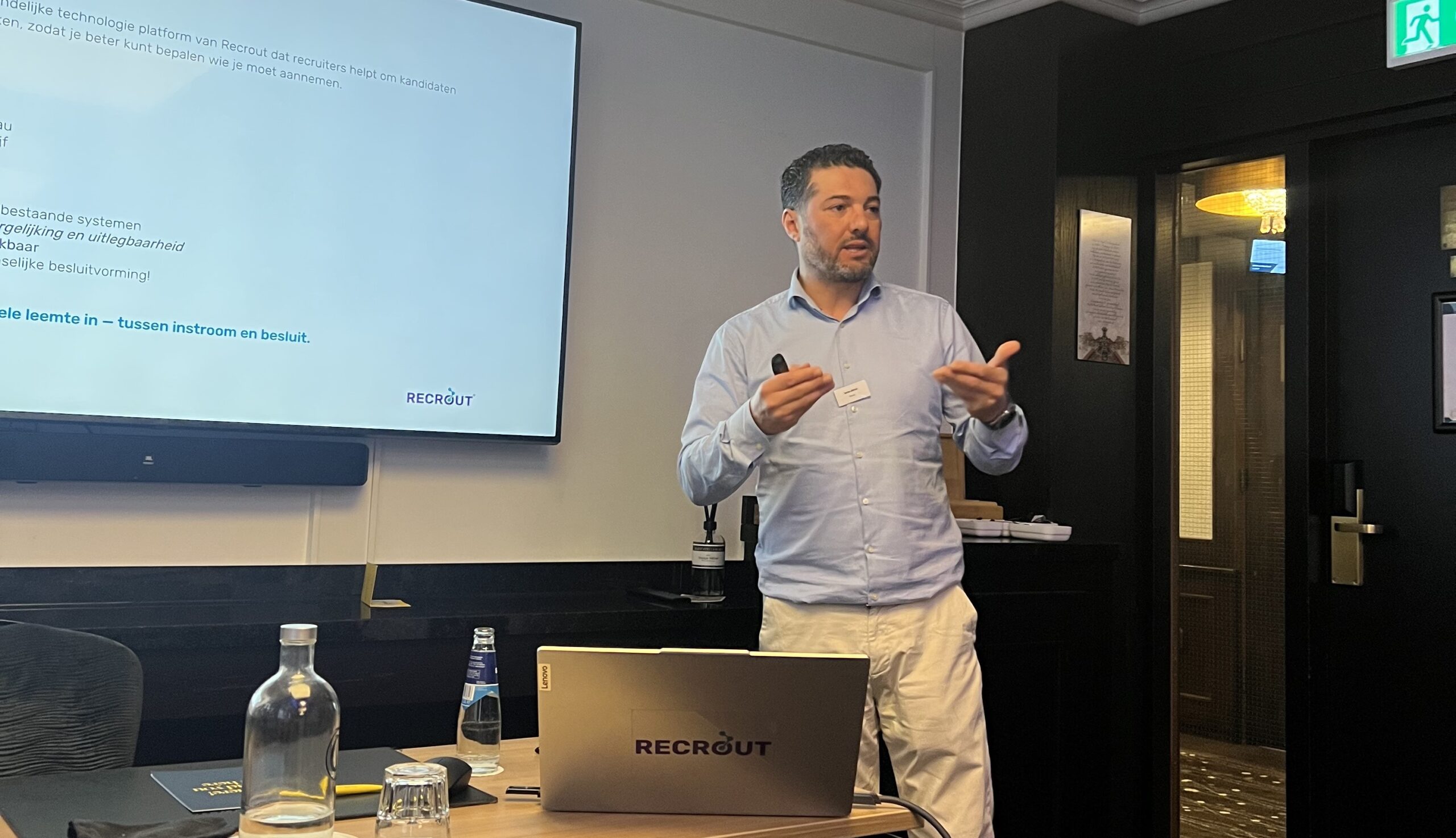


Recrout was born out of frustration. CEO Karim Akhlal initially ran his own old-school offline recruitment and selection agency. In short, Akhlal would gather suitable résumés for open positions. “I thought, now I have a list of what the manager wants. I have a well-matched résumé, but every time I was told: there’s no match. The reason? Personality—there’s no chemistry or the candidate doesn’t fit in the team. Then all the things that were correct no longer mattered. Often it’s like this: you’re hired based on your résumé and fired based on your personality, and that frustrated me. So I thought: if that’s so important, there must be an easier way.”
This is how Recrout was born. “It is an online recruitment platform where we match job seekers with employers based on so-called soft skills. Unlike the traditional method, which focuses on the résumé, we look at people’s talents, competencies, motivations, and personality traits—those aspects that ultimately determine whether someone will be successful. A résumé alone will never determine whether someone will change the world; that always comes down to people with specific talents, personalities, character, or motivations. That is what we primarily match on. (…) We want to go deeper: what are your talents? What are you good at? What do you have a natural aptitude for? Based on that, we’ve built a sort of matching engine with algorithms around it. We try to predict, based on who you are and where your strengths lie, the best possible matches.”
“We want to help you map out your talents.”
Recrout starts where most applications end: at the assessment. Job seekers are required to create an online profile. This consists partly of a résumé, but also includes a talent assessment that maps 45 competencies and talents. Based on the results, employers can decide whether to invite you for an interview. “When you sign up, you don’t know what you’re applying for, so you don’t know what will be looked at. That’s why we also say: if you take the talent assessment, do it for yourself. We want to help you map out your talents—just be honest.”
Akhlal is convinced that computers can match people better than humans can. “With all the science and technologies we have, I find it rather outdated that people are still selected or rejected based on a sheet of paper, where the human factor always gets in the way—gut feelings, not being able to identify with the candidate, or other strange issues. A computer doesn’t suffer from that; it purely looks at what you’re seeking as an organization and which skills and talents are needed. The computer then tells you, based on science, who the best candidates are.”
To achieve a good match, it is also important to map out companies. “A candidate may look perfect on paper, but if the company culture doesn’t resonate, it will still fail. Companies are therefore asked to map their company culture. The key question is: which behaviors lead to success? That is how we define company culture.”
At the moment, creating a profile as a job seeker does not automatically generate recommendations for companies where you would be a perfect fit, regardless of whether a vacancy exists. “Right now, we are still a fairly closed platform, but we are working on integrating external vacancies that are not ours. This way, we can serve our members even better by saying: we don’t have vacancies for you, but here is a whole list of other opportunities that do match. Go take a look.”
“We are searching for the holy grail of recruitment.”
The team behind Recrout currently consists of five people. Around 2,000 people have created profiles, and 20 to 25 companies—including Capgemini and Accenture—are using the platform. All of this has happened within a year, during which the platform also faced its share of criticism. “We have learned from our mistakes. We have done a lot in terms of development and improvement.”
Creating a profile, including the assessment questions, will become faster. “You won’t spend an hour on it—you’ll be done in just a few steps. The assessment will still take about half an hour, but there’s always a balance between quality and speed. People ideally want to finish in two minutes.” But that comes at the expense of quality.
Recently, Recrout received a nomination for Best Recruitment Tool of 2015. To date, the company has been entirely self-funded. Strong growth is therefore important—both in terms of the number of paying companies and the number of profiles. Recrout also hopes to generate revenue through a licensing model, allowing the software to be used internally by large companies.
And although things are starting to get exciting for Recrout and the financial bottom is in sight, Akhlal believes in success. “Ultimately, we are searching for the holy grail of recruitment. We want to find the answer to how you can predict, based on data, which person will be successful within your organization. (…) We are not after a quick win. We don’t need to make an exit in a year. I want to still be here in twenty years, but by then as a market leader and the best in the industry. This is truly my thing. This is what we are striving for.”